AI Job Impact
Sep 10, 2025
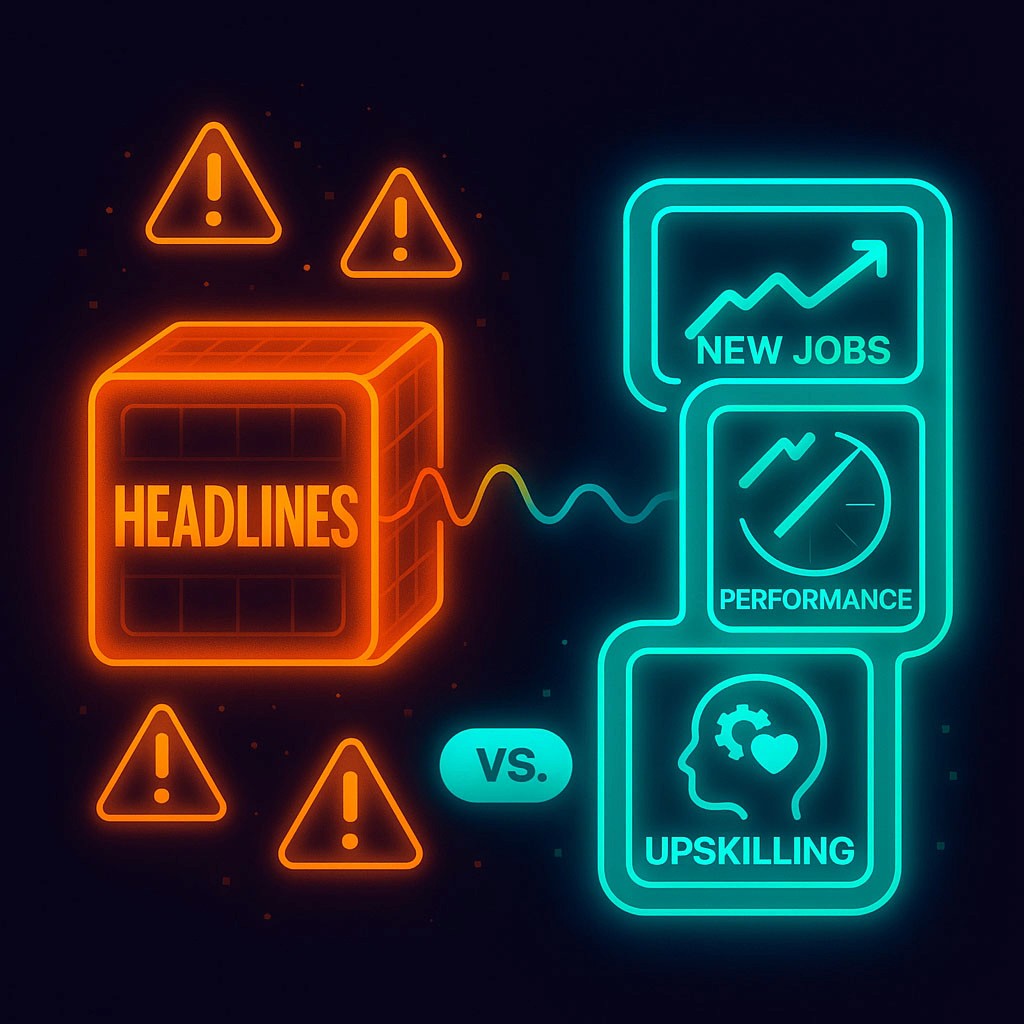
The recent headlines have been shocking; experts warning that artificial intelligence (AI) will replace millions of jobs in almost every industry. But the reality is that recent data paints a different picture. In this month’s blog, we’re sharing some statistics and insights about the potential impacts on jobs in the “Age of AI.”
Latest data from PwC, McKinsey, and the World Economic Forum show that AI isn’t eliminating jobs; it’s transforming them and enabling workers to focus on value-added work instead of repetitive tasks. In other words, AI is helping many teams work more efficiently and effectively. Additionally, roles most exposed to AI are growing, compensation is rising, and entirely new career paths are emerging.
The Real Data Behind the AI Job Market
PwC’s 2025 Global AI Jobs Barometer analyzed close to a billion job postings across six continents and found something surprising: job availability grew 38% in roles most exposed to AI between 2019 and 2024. Professionals with AI skills command an average 56% wage premium in 2024—up from 25% the year before.
A separate analysis of 1.3 billion postings (Lightcast, 2025) found that roles requiring at least one AI skill offered ~$18,000 more in annual compensation (~28% higher) and that 51% of AI-skill postings in 2024 were outside IT and computer-science occupations.
Meanwhile, the World Economic Forum projects 170 million new roles created and 92 million displaced by 2030—a net +78 million jobs. Rather than trying to tally net jobs, McKinsey focuses on tasks: up to ~30% of hours worked could be automated by 2030, implying major occupational transitions rather than a simple job-count story.
Is Artificial Intelligence Really Killing Jobs?
The shift isn’t about jobs disappearing—it’s about jobs evolving. In WEF’s 2025 outlook, AI and information-processing technologies are expected to create ~11 million jobs and displace ~9 million by 2030 (net +2M), as part of the broader +78M net effect across macrotrends.
Emerging Roles in the AI Economy
Across Design & Make industries (architecture, engineering, construction, product design, manufacturing, media, entertainment), Autodesk’s 2025 AI Jobs Report shows sharp gains in AI-titled roles: AI Engineer +143.2%, AI Content Creator +134.5%, Prompt Engineer +95.5% (2025 YTD).
And these aren’t just technical jobs. In this same dataset, design skills now outrank coding and cloud as the most in-demand skills in AI-role postings, with communication, leadership, and collaboration also prominent—the human strengths that complement technology. (Scope: Design & Make industries.)
Recent analysis from the Budget Lab at Yale (with Brookings collaborators) finds no economy-wide evidence of AI-driven job loss through 2025 so far. Their conclusion: the labor market shows “stability, not major disruption.”
How Is AI Reshaping Skills & Upskilling?
Here’s where things get interesting. According to PwC (2025), the skills employers seek are changing 66% faster in AI-exposed jobs (up from 25% last year). Employers are also dialing back formal degree requirements, especially in AI-augmented and automatable roles: 66%→59% (AI-augmented) and 53%→44% (automatable) between 2019 and 2024. Translation: the market is rewarding adaptability and applied capability, not just degrees.
Where Are “AI” Opportunities Growing?
The share of U.S. jobs in STEM rose from 6.5% (2010) to nearly 10% (2024)—about a 50% increase—and, importantly, more than half of AI-skill job ads in 2024 were outside tech.
Industries Adopting AI Fastest
Fields such as marketing, HR, finance, education, manufacturing, and customer service are rapidly integrating AI tools into day-to-day work. Healthcare is another standout. Rather than replacing professionals, AI is augmenting their roles. BLS 2024–2034 projects Nurse Practitioners +40.1% and Software Developers +15.8%, both well above the ~3.1% average for all occupations. (Using a consistent 2024–2034 horizon.) (Bureau of Labor Statistics)
Our Take: AI Is Amplifying Human Expertise
The AI landscape is changing quickly and impacting the human experience at work. AI isn’t eliminating the need for human expertise—it’s amplifying it. The companies and professionals who understand this shift are already ahead of the curve.
As the data shows, employees who embrace AI tools tend to see higher wages, broader opportunities, and faster career growth. The real question isn’t whether AI will take your job; it’s whether you’ll adapt to it.
The Bottom Line on AI and Jobs
Artificial intelligence isn’t the end of human work. It’s the next evolution of it. The most successful professionals won’t be those who avoid AI but those who learn to use it strategically and tactically. The job market is shifting toward higher-value, more adaptive roles where creativity, communication, and problem-solving matter as much as technical skill. The question isn’t if AI will change your work—it’s how you’ll respond. (PwC)

Ready to Work with Partners Who Get It?
If you're tired of AI hype and ready for AI results, let's talk. We'll help you identify where AI can make a real difference in your business—and how to make it happen.